How Does An Endoscope Bending Section Work?
Leave a message
Understanding the Structure, Articulation Mechanism and Common Failure Points
A flexible endoscope needs to navigate through complex anatomical pathways while maintaining precise control at the distal tip.
One of the key components that makes this possible is the Bending Section.
Although it is relatively small, the bending section plays a critical role in controlling the direction of the endoscope. Its mechanical structure directly affects angulation, flexibility, responsiveness and durability.
So, how does it actually work?
1. What Is an Endoscope Bending Section?
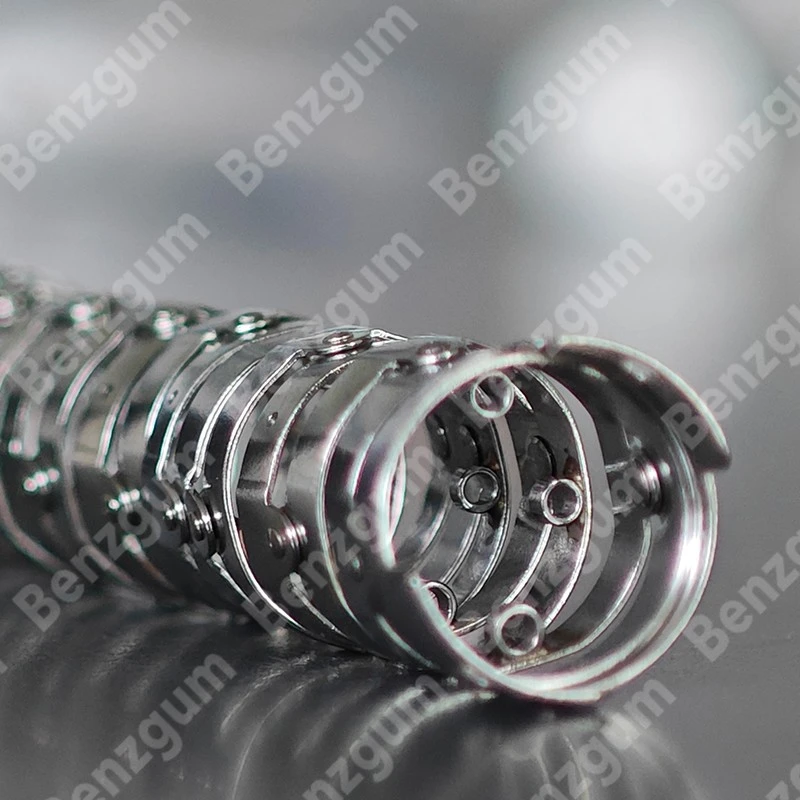
The Endoscope Bending Section is the articulated mechanical structure located between the insertion tube and the distal tip.
Its primary function is to allow the distal end of a flexible endoscope to bend in controlled directions.
Unlike a simple flexible tube, the bending section is composed of multiple interconnected components that work together to transform movement at the control section into precise tip articulation.
A typical bending system includes:
- Bending Section
- Bending Mesh
- Angulation Wires
- Bending Rubber
- Internal support and connection structures
Each component has a different role, but their performance must be closely matched.
2. How Does the Bending Mechanism Work?
The basic principle is relatively simple:
Control → Wire Movement → Bending Section Articulation → Distal Tip Movement
When the operator turns the angulation control knob, the corresponding angulation wire is pulled.
The tension transmitted through the wire causes the articulated segments of the bending section to move relative to one another.
As the segments move together, the distal tip bends in the desired direction.
In simple terms:
The control knob creates the movement.
The angulation wire transmits the force.
The bending section converts that force into controlled articulation.
This is why the mechanical relationship between these components is so important.
3. What Is Inside a Bending Section?
A bending section is not simply a flexible metal tube.
Its internal structure is designed to provide both controlled movement and mechanical support.
Bending Segments
Multiple segments form the articulated structure.
Their geometry determines how the bending section moves and how smoothly the curvature develops.
Bending Mesh
The Bending Mesh provides an important structural layer around the articulated section.
It helps maintain the overall shape and protects the internal components while allowing the bending section to remain flexible.
Angulation Wires
The Angulation Wire transfers the operator's input from the control mechanism toward the distal end.
Wire tension, routing and attachment all influence the responsiveness of the bending system.
Bending Rubber
The Bending Rubber covers and protects the articulated mechanism.
It helps create a smooth external surface while protecting the internal structure from contamination, mechanical stress and repeated bending.
4. Why Is the Bending Section So Important?
The bending section has to satisfy several requirements simultaneously.
Precise Articulation
The distal tip needs to respond accurately to control input.
Smooth Movement
Excessive resistance or friction can make the endoscope difficult to operate.
Repeated Flexing
During its service life, the bending section may undergo a very large number of bending cycles.
Mechanical Protection
The internal wires and other components must remain protected while the section repeatedly changes shape.
Dimensional Compatibility
Even a mechanically well-made component may not be suitable if its dimensions, interfaces or configuration do not match the original system.
This makes the bending section a component where precision and compatibility are equally important.
5. What Causes Bending Section Problems?
Because the bending section repeatedly moves during use, it is exposed to continuous mechanical stress.
Common problems can include:
① Reduced Angulation
The distal tip may no longer reach its original bending angle.
Possible causes include:
- Wire elongation
- Wire damage
- Mechanical wear
- Increased internal resistance
② Stiff or Uneven Movement
The control knob may require more force than usual.
This can indicate problems involving the wire system, articulated structure or internal friction.
③ Loose or Unresponsive Tip
The control input may not be transmitted effectively to the distal end.
This can occur when the mechanical connection or wire system has deteriorated.
④ Damaged Bending Rubber
Repeated bending, external pressure and aging can eventually cause cracks, deformation or surface damage.
⑤ Bending Section Deformation
Mechanical impact or excessive bending can affect the geometry of the articulated section.
6. Why Does Bending Section Matching Matter?
For endoscope repair, replacing a bending section is not simply a matter of finding one with the same general appearance.
Important parameters may include:
- Outer diameter
- Overall length
- Segment dimensions
- Hole position
- Wire configuration
- Connection structure
- Bending direction
- Compatibility with the corresponding endoscope model
A small dimensional difference can affect installation, articulation and overall mechanical performance.
This is why model compatibility and dimensional accuracy are critical when sourcing replacement bending sections.
7. Bending Section vs. Bending Mesh vs. Bending Rubber
These terms are sometimes confused, but they are not the same component.
| Component | Main Function |
|---|---|
| Bending Section | Provides the articulated mechanical structure |
| Bending Mesh | Supports and protects the bending assembly |
| Bending Rubber | Provides external protection and flexible covering |
| Angulation Wire | Transfers control force to the distal tip |
Together, they form an integrated bending system.
A failure in one component can affect the performance of the entire assembly.
8. What Should Repair Companies Check?
When evaluating a replacement bending component, repair technicians and distributors should look beyond price.
Mechanical Compatibility
Does the component match the original structure and connection points?
Dimensional Accuracy
Are the diameter, length and segment dimensions appropriate?
Angulation Performance
Can the bending section achieve the required movement smoothly?
Material Quality
Can the material withstand repeated bending and mechanical stress?
Assembly Consistency
Are the wire interfaces and structural connections properly matched?
Customization
For less common models, can dimensions or configurations be customized?
These factors can significantly influence repair efficiency and final performance.
9. Where Does the Bending Section Fit Into the Entire Endoscope?
The bending section works as part of a larger mechanical system.
Control Section
↓
Angulation Mechanism
↓
Angulation Wires
↓
Bending Section
↓
Distal Tip
At the same time, the bending section must accommodate and protect various internal pathways, including:
- Biopsy channel
- Air/water channel
- Light guide system
- Electrical and control components
This is why bending-section design involves much more than simply creating a flexible joint.
10. A Small Component With a Big Impact
The bending section is one of the best examples of how flexible endoscope performance depends on the interaction of multiple precision components.
A problem that appears to be "poor angulation" may actually involve the angulation wire, bending section, bending mesh, bending rubber or their interfaces.
For repair companies, understanding this relationship can help with:
Better fault diagnosis → Better component selection → More efficient repair → More reliable endoscope performance
Supporting Flexible Endoscope Repair
At Benzgum Medical Technology, we focus on components used in flexible endoscope repair and refurbishment.
Our product range includes:
►Endoscope Biopsy Channel Tube
►Endoscope Coil Pipe & Assembly
►Endoscope Bending Section& Assembly
For different repair requirements, component dimensions and configurations can be evaluated according to the target endoscope and application.
Explore our Flexible Endoscope Components:
Surgica Supply - Endoscopic Instruments
Final Takeaway
The bending section may look like a small mechanical assembly, but it is responsible for one of the most important functions of a flexible endoscope: controlled distal-tip movement.
Understanding how the bending section, angulation wires, bending mesh and bending rubber work together is essential for effective troubleshooting and component replacement.
Precision at the component level can make a significant difference to the performance of the entire endoscope.