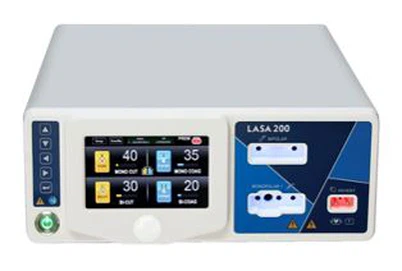
Argon Plasma Coagulation
Leave a message
Argon plasma coagulation (APC), also known as argon knife, has been widely used in open, endoscopic, and endoscopic surgeries in recent years due to its excellent effects such as fast hemostasis, minimal blood loss, reduced oxidation, and eschar formation. Its working principle is to use high-frequency voltage provided by Electrosurgery equipment to stimulate argon to form conductive argon plasma to form a closed circuit, so as to achieve the effect of superficial unipolar coagulation or tissue inactivation. Argon plasma coagulation is a unipolar non-contact coagulation mode.
When the high-frequency and high-voltage output electrode of argon plasma coagulation is activated, argon gas is sprayed out from the handle, and the current between the electrode and the target tissue is transmitted to the target tissue to produce good hemostatic or tissue inactivation effects. The traditional jet electrocoagulation mode, due to the complex composition of air between the electrode and the bleeding wound, is difficult to ionize, has low ion concentration, and poor conductivity. Therefore, the current is transmitted to the target tissue in the form of an arc, resulting in poor coagulation effect. Moreover, the air is rich in oxygen, not inert gases such as argon. Therefore, traditional jet electrocoagulation has large smoke, easy tissue carbonization, and a peculiar smell. In comparison, argon plasma coagulation, as a special mode of achieving electrocoagulation using inert gas argon ionization, has good therapeutic effects.